Don't forget: you can click on an image to enlarge it!

Monday, 13 February 2017

Iceland Gull, Hooded Crow and other goodies at Mautby.

A break in the weather coincided with Linda being on Half Term and me suddenly feeling lots better, so a trip out to Mautby seemed in order. Linda hasn't seen a Hooded Crow since her trip to Scotland with Dot Machin before we were married, so it was too good a chance to miss.

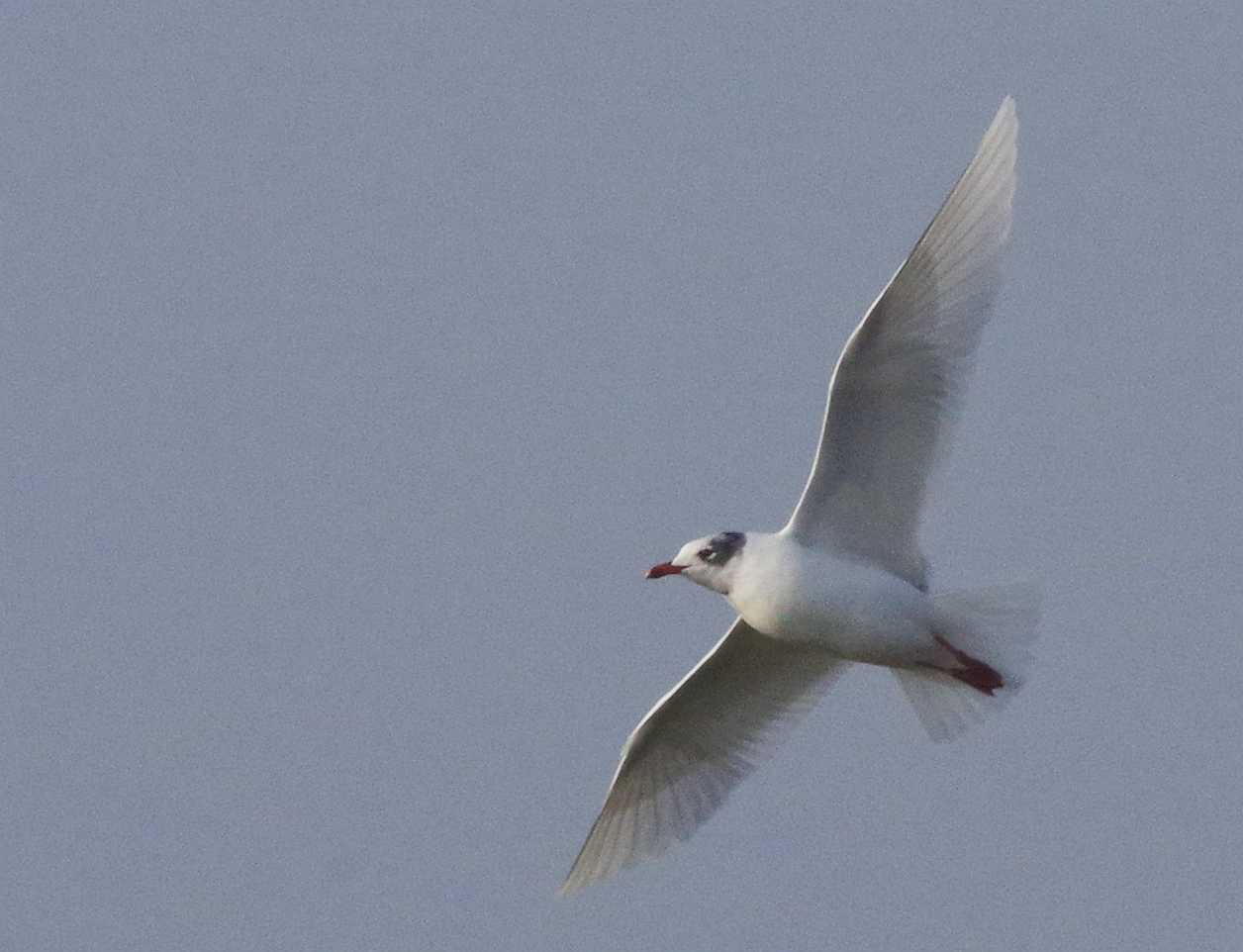
For over an hour we were the only birders on site, but managed to find both the Hooded Crow and one of the possible hybrids - both somewhat distantly, but good fun, nonetheless. As we were searching through the large numbers of Gulls, it became apparent that there were quite a few Mediterranean Gulls, including one that was well-advanced towards breeding plumage. I also picked out one that seems a reasonable candidate for Caspian Gull: all sensible suggestions very welcome!

Two more birders appeared and the first of these located the elusive Iceland Gull hunkered down in the grass. Some vehicle relocation down the hill brought us closer to the bird, where the second new-comer (from Holt) picked up the Iceland a little closer to the road: thanks to both for adding their eyes (and scopes!) to the search.

On the way home we stopped for some shopping at ASDA where a quick glance across Breydon from beneath the bridge revealed the reported Glaucous Gull some distance away on the mud...


Sunday, 12 February 2017

Snowgulls!

We often have a few gulls in and around the garden, particularly if Linda throws out bread scraps: today, however, was exceptional!

Overnight there was a reasonable sprinkling of snow on the Heath: it's turning to rain as I write this, but it looked pretty first thing! With her characteristic consideration for 'our' wildlife, Linda was out before dawn, filling the garden's eleven feeders and three water baths: she decided to supplement the regular seeds with crushed up fat balls, which were scattered across the lawn. Within a minute a large group of gulls had begun to gather in the trees and hedges: Black-headed Gulls, Herring Gulls, Common Gulls and a Lesser Black-back-backed that swooped down, snatched a whole fat ball and flew off with it.

Absolutely fascinating to watch the interactions between the various ages / species of gull, even if they did hoover up all the food in about thirty seconds!


Saturday, 11 February 2017

A gloomy day brings in the birds...

A quick run into Norwich for breakfast at the excellent 'Bill's' and a visit to the St Andrews Antique Fair saw Linda and I back home before midday.

The day was overcast, with a continual threat of snow, and it's almost as if the birds are anticipating a lean spell: the garden has been full all afternoon. Blackbirds have forgotten their usual intolerance to each other: at times there were over a dozen feeding together on suet. Similarly, up to five Robins have been flitting around together. Overhead a couple of Buzzards loitered, while Red-legged Partridges, Pheasants and - most welcome - a Stock Dove have been feeding and drinking from the ponds all afternoon.


Friday, 10 February 2017

Great Bustards: thirtieth anniversary!

Just a quick pre-amble: since I'm still unable to walk or drive far, and because the cold weather really wouldn't assist in the pneumonia healing process, I've decided to post what I hope most of you might find to be interesting Norfolk birding anecdotes.

In the 1987 BBRC annual round-up, one can read:

Great Bustard Otis tarda
Norfolk: New Buckenham, two immature males, 7th to 10th February (A. J. Prater, R. Shaw et al ).
The 'R Shaw' listed as a co-discoverer of these fabulous birds was, in fact, Robin Shaw, at the time a good friend and former colleague of mine at Hellesdon High School. He was predominantly an RE teacher, but, like me, also worked with some of the more challenging pupils in what was called the Enterprise Department. He was a very keen wildfowler and rough-shooter and lived in an old farm in New Buckenham.

One day he was shooting pigeon in emerging rape fields near Carleton Rode when he came across two large, unfamiliar birds. Unusually, he didn't blast them to perdition, but - so he told me later - went and alerted Richard Millington, who lived in New Buckenham at that time.

I heard about the birds on the 9th (Monday) and, although I knew the timing was going to be touch and go, resolved to have a look the next morning before work. I had recently started a new job as KS2 leader at Acle Primary School, so wasn't going to rock the boat by 'throwing a sickie' or turning up late. The Headteacher knew perfectly well I was a keen birder (a factor in appointing me to replace Norfolk bird personality Bill Urwin!) and would have guessed without too much trouble where I'd really been!

Accordingly, I arrived well before dawn to find the hedges already lined with silent, anticipatory birders. I parked where I could, then joined the crowd. Among these were two people who were to become great chums: Martin Read and his then partner, Sally. Later these two, Linda and I would undertake many twitches together and two or three Scillonian pelagics.

I stood with Sally and Martin for perhaps an hour: the sky began to lighten perceptibly, but time was pushing on: I glanced repeatedly at my watch before making the agonising decision to leave. I said my goodbyes (Martin had already decided to call in sick to his teaching job!) and walked back towards the car. As I climbed in, I looked back and saw Sally and Martin waving an apparent farewell: you've guessed it: Martin phoned later to say they were trying frantically to alert me to the fact that the Bustards had just stood up fifty metres in front of them! (How
could two huge birds hide so well in a six-inch high rape crop?)

There are two footnotes to this story. When I arrived at Acle  just before the start of school, I told the Head where I'd been: of course, he said I should have hung on for an hour or two: ("Bill would have! I could've covered for you!")


A final note: the following weekend I was walking the 'back route' into Winterton Blocks from Somerton when I flushed a large bird out of  a stubble field: as it flapped across the ground (somewhat reminiscent of a Mute Swan's take off strategy!) it displayed startling white wing patches: I raised my binoculars: Great Bustard!

Not the Buckenham birds!
 

Thursday, 9 February 2017

Penumbral lunar eclipse

If any of you are night owls and happen to have a clear sky around midnight on Friday, then you could enjoy (if that's the right word!) a near-total penumbral eclipse of the Moon.

Eclipses of the Moon occur when the Earth blocks some or all of the sunlight reaching the Moon. (The Moon, of course, is not self-luminous - it shines by reflecting the Sun's rays) As the diagrams below demonstrate, the Earth's shadow creates a dark, fully-shadowed region called the umbra and a region where some light enters: this is called the penumbra.

Friday's lunar eclipse is penumbral, which means the Moon will appear somewhat dimmer than normal, but not as much as during a full umbral eclipse. Still : interesting to see if the sky is clear!

Umbral eclipse

Penumbral eclipse

Wednesday, 8 February 2017

Unbelievable!

Following Monday's post about the Loch Ness Monster, I received quite a lot of feedback, most of it polite if, in a couple of cases, a little sceptical: that's fine! However, one or two comments left on here (for the 600+ daily visitors to read) have been of a different category altogether, verging on the libellous. Needless to say, the authors of these elect to remain anonymous: very brave!

Here's a typical one from last night:

Hi David, Please do not censor my comment or delete it. Can you honestly say that this is not another photoshop job? Many of your pictures (usually rare birds) have a distinctly different look to them. I don't understand if you are doing this as a joke or to troll people or are just very bored at home? It's not a nessie is it David? Let's stop the games.
 
Well of course the first point to be made is that I actually stated in my post that the image was one I had drawn for one of my books. I have never claimed here or anywhere else to have photographed the LNM, but when I wrote my second book, the editor suggested I generate an image with Paint Shop Pro to illustrate a point I was making.

Secondly, I would love to know which photos ('usually of rare birds') I'm supposed to have faked. On 99% of the occasions when my images were taken I was with two, three or more companions. In common with the vast majority of 'fun' photographers, I might occasionally use Irfanview and/or PSP to improve the look (but not the content) of an image. For example, here's a photo of a Blackbird I just took from my window: it's still nearly dark here, but the image can be improved a little by increasing the brightness and contrast, using edge preservation, salt and pepper filter and sharpening:


Of course, you can't make a silk purse from a sow's ear, so this was never going to be a good photo of a Blackbird. But supposing it had been a Blue Rock Thrush? I would contend it would be entirely legitimate to brighten and sharpen the image to improve its value as an I/d tool.

Thirdly: isn't it a little ingenuous for the anonymous writer of the above to ask that I not delete his/her comment? I can only assume they derive a little frisson of excitement from seeing their abuse on a popular wildlife blog...

You know, almost all the bird better-known bloggers have click-throughs, sponsorship and adverts on their sites: I have none of these. Birds of the Heath is quite simply an account of what I get up to on a daily basis. I try not to fill it with trivia about my family / pets / political beliefs and I can honestly say I never use the blog to make personal attacks on other people or their records. If the writer of the above comment would like to e-mail or phone me (contact details on any of my websites) perhaps we could discuss the matter.
 
Those that know me know that I have had a colourful and full life: I really was an officer in the Navy, I really have played in a number of successful folk and rock bands, I really am the UK's only full-time meteorite dealer, I really have been lucky enough to have met and spent time with numbers of historical and media personalities, I really have written dozens of magazine articles and books and I really have seen well over 400 species of bird in the UK and photographed 342 of them. I don't need to bolster a tiny ego by attacking people or making spurious claims. (As an example: I've been to Mautby four times without seeing the Iceland Gull: I've only seen the Hooded Crow once. Why would I persevere if I could just generate 'another photoshop job' ?)
 
OK: sorry about this somewhat lengthy ripost to the handful of insulting and spiteful comments that Monday's post engendered: I hope regular readers will understand why I felt the need to say something...

Monday, 6 February 2017

Loch Ness Monster!

As Linda and I were walking around the antiques fair on Saturday, I came across two little 'Sea Serpent' ornaments, which I bought for next to nothing. I used to have lots of these, but as will happen, they 'disappeared' after I divorced my first wife.

Most of these were collected when I spent several weeks in 1973 and 1972 researching and writing a book about the Loch Ness Monster. My interest in the loch goes right back to the early 1960s, when my brother and I managed to persuade our parents to take several summer holidays in the Great Glen. As an 11 year-old, I found camping by the loch a thrilling experience: the dark, brooding waters, high fringing mountains and rapidly-changing weather imparts to Loch Ness a feeling that almost anything might occur in its thousand foot depths. The first illustration below is of my brother Rob (on the right!) and me by the Loch in, I should imagine, 1963. The curious vehicle we are proudly leaning against was unique: made by the 'Dormobile' company, Martin Walters, it featured a removable dinghy as a roof extension. Believe it or not, my brother and I slept in this 'loft space' in hammocks while our parents were below! Can't really imagine modern teenagers being too impressed! Our father was quite high up in the Ford commercial vehicle section and was allowed to borrow similar campers whenever he wanted.

As a pragmatist, I arrived at the loch in 1972, convinced that a large oligotrophic body with very little fish life other than migratory species could not possibly support a breeding colony of large creatures. Numerous surveys carried out by me and fellow-author Phil (a chemist) lent weight to this idea. During our two expeditions, we interviewed all the surviving famous witnesses and chatted with the major personalities: Tim Dinsdale, Adrian Shine, Robert Rines being the most convincing.

The bizarre thing is that - having convinced ourselves that Nessie must be purely a creature of legend - we saw it (or one of them!) at close range! The image below is one I drew for one of my books.


Some of my many LNM books (and the two little monsters!)

Mobile camera unit in the 1960s. There were several around the loch

LNIB headquarters in - I think - 1966

My sighting in 1972: range 100 metres

Saturday, 4 February 2017

Antiques roadtrip!

Well: not really! But Norwich is fortunate enough to hold a regular antiques fair at the Norfolk Showground, which Linda and I try never to miss. Despite the cool breeze and threat of rain, we wrapped up warmly and were on the prowl by 10 am.

The gales and rain last night put off many of the outside pitch dealers, and we failed to find anything to add to our collections of British vintage porcelain. Once inside, though, there was lots more to look at. You don't have to be a collector to enjoy these shows - there are some amazing things on offer, including old signage, vintage clothes, taxidermy, rare and beautiful glass and porcelain, books, militaria, paintings and prints...

Including a stop for coffee and cake, we spent three hours (and a few pounds!) and had a thoroughly enjoyable morning.


Thursday, 2 February 2017

Black-necked Grebe at Thorpe Marsh and Bean Geese at Billockby.

I had another Dr's appointment today, but it was rescheduled, leaving me with a couple of free hours. I thought I'd have a look at the Tundra Beans that had been reported from Billockby, near Acle, and found them amongst a huge flock of Pink-feet without too much trouble. Unfortunately the only parking place was down a side road, which put the Beans on the far side of the flock, so a record shot only. I counted at least forty!

Since I was in the area, I decided to pop over to Mautby: no sign of either the Iceland Gull or Hooded Crow, but there were dozens of Mediterranean Gulls - see if you can pick them out in the flock photos! There were quite a few birders there, one of whom kindly told me that a Black-necked Grebe was showing at Thorpe Marsh, just outside Norwich. Since this was a Yare Valley tick for me, I headed west.

Not having any gen, I walked all the way around the lake (which nearly killed me!) before bumping into a friendly lady birder who said it was supposedly in the south west corner: I pointed out that she was in the south east corner! We re-oriented and met a very friendly birder with a 'scope, who had found the tiny bird tucked against the far reeds. After a few very distant record shots, we carried on back to our cars: I quickly realised we should be able to get somewhat closer views through gaps in the path-side reeds. And indeed we did! Still distant, but close enough to see the startlingly red eye.