Don't forget: you can click on an image to enlarge it!

Wednesday, 8 March 2017

Great day on the North Coast: Pallid Harrier, Red Kites, Shorelarks and plenty more besides!

Despite overcast skies and persistent drizzle, Brian T picked me up at 7.15 for a cruise along the North Coast. First stop was Cley: we parked at the end of the East Bank and walked out to the sea in the hope of catching up with the long-staying Smew. No sign, unfortunately - just a few of the expected birds: Little Egret, Wigeon, Curlew and so on.

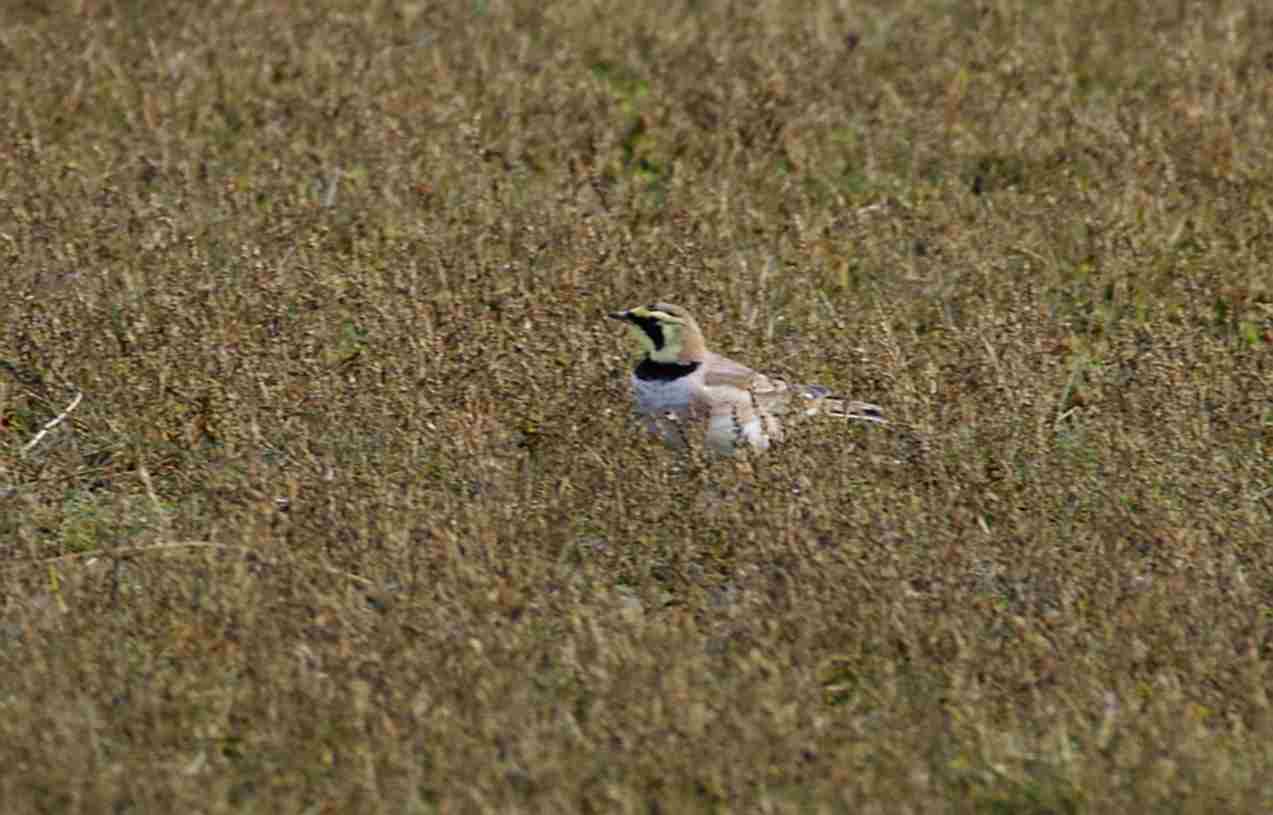
We continued westwards to Holkham: Brian hadn't seen the Shorelarks this winter, but a brisk walk to the right of the Gap soon revealed a group of thirty or so. The presence of many boisterous dogs and their thoughtless owners made decent photography difficult, but we managed a few record shots.

Since we were so close, it seemed silly not to have a look for the Pallid Harrier at New Holkham: a large gallery by the roadside indicated that the bird had been located. This was indeed the case, but you'll see from the photo below that it was very distant and hunched down in the cereal stubble. A couple of friendly locals let us look through their 'scopes and, even at a range of around a mile, it was possible to make out the head markings and apricot breast. This was the fifth I've seen in Norfolk, so we didn't stick around in the hope of closer views.

Last stop was Titchwell for lunch: a Linda McC veggie sausage bap made an excellent change from the usual cheese scone! We walked out to Patsy's Reedbed where we added two Red Kites and a couple of dozy Red-crested Pochard to the daylist. Best find of the day, though, was a small pool full of mating frogs: over 500 with absolute mounds of spawn! The walk out to the seashore provided views of all the usual waders (Knot, BT Godwits, Dunlin, Oycs and so on) as well as two smart Mediterranean Gulls. Even with the tide coming in, the smallish Scoter flock was incredibly distant. Even so, it was possible to pick out a few Velvets, a Long-tailed Duck and a couple of Scaup.

On the was back to the car park I noticed four Elf Caps - how cute are they!? Brian says there are some at Strumpshaw: I shall have to keep an eye open for them...


Tuesday, 7 March 2017

A quick walk around the Fen and Buckenham Marsh

I had to stay at home to wait for a plumber, so couldn't get to the Fen (where I'd arranged to meet Brian T)  until 10 o'clock. Although his car was in the car park, he wasn't at reception or Fen Hide (and neither were any birds!) so I carried on round to Tower Hide. A couple of the regulars were there and pointed out the only birds of note - a pair of Common Snipe - and also told me that Brian had carried on round the reserve via Lackford Run. Since I didn't have chest waders, I returned to Reception, where we met after a brief wait. Some pleasant 'Summer Winers'  (from Bungay and Norwich) to chat with, but, in the absence of any interesting birds, I said my goodbyes and drove round to Buckenham Station.

The walk out to the River Yare and back finally produced some birds - albeit distantly! A Peregrine watched me walk past from the usual tree, while a large flock of Golden Plover wheeled overhead.  Further away, over Claxton, a mixed murmuration of Starlings, Lapwings and more Golden Plover made shapes in the sky...

The distant scrape (when will the RSPB move the 'hide' so that it actually overlooks this?) held three Avocet and five Ruff, while a pair of Little Egrets flirted with each other in the sunlight.


Crazy, mixed-up kid!

The vast amounts of seed with which Linda stocks the garden feeders attracts plenty of custom: Pigeons, Doves, Partridges, Gulls, Crows, Blackbirds and, of course, Pheasants. There's a purpose-built ground feeder for them, since they're often present in large numbers: our record is 23 together!

This isn't to the taste of one of the regular clients: this female Pheasant has learned to climb up to the garden's various fat and suet feeders that are intended for Tits and Woodpeckers - she can empty one in minutes!


Monday, 6 March 2017

Jack Snipe, Bittern and Chiffchaff at Strumpshaw Fen

Following my daily trip to the Post Office, I carried on to the Fen to take advantage of a somewhat warmer morning. A large group of 'Nordic Walkers' in pink kagouls were milling about Reception Hide (this being the RSPB's latest fund raising idea!) so I didn't stop. Fen Hide was less crowded: ex-colleague Nigel, photographer Eddie and - a legend in his own lunchtime - Mike 'Red' O'Hara. It was pleasant to shoot the breeze and catch up with news: Red hardly seems to have missed anything for six months (apart from the Hooded Crow at Mautby!) Apart from a good number of Buzzards passing through, there was little about, so we moved on, heading east along the river bank.

By the reserve's back entrance we stopped to listen to the first Chiffchaff of the year: eventually we managed some decent pictures. As we watched the bird and conjectured whether it had over-wintered, at least three more started to call: obviously there'd been an arrival!

Red carried on back to Fen Hide, so Nigel and I returned to Reception to record the Chiffies: fortunate that we did, because we quickly added Jack Snipe and Bittern to the day's total!


Sunday, 5 March 2017

Beautiful Moon...

Gorgeous first quarter Moon tonight, close to Taurus and Orion. It occulted Aldebaran last night, but it was cloudy here.


Car boot bonus!

Linda and I made our near-weekly trip to the Harford Park & Ride car boot sale to pick up more mealworms, suet, seeds etc. (Linda spends about as much on the birds as I do on our fruit and veg each week!)

As usual, I had my camera handy (ever since the Eagle sp. incident!) No eagles today, but two very vocal Oystercatchers and a couple of Buzzards displaying in the hazy sunshine.


Saturday, 4 March 2017

Lies, damned lies and statistics...

If, like me, you have been sickened by online images of ATVs laden with dead Mountain Hares or Hen Harriers and Golden Eagles rotting on Scottish grouse moors, you may wonder what constitute the real threats to our wildlife and environment. Here are some checkable facts about climate change:

· The Intergovernmental Panel on Climate Change (IPCC) is a scientific and intergovernmental body that monitors global climate change and reports its findings and suggestions to the United Nations and at periodic conferences.
· It is generally considered that human influence on global temperature became a theoretical possibility from 1950. Since this date the GW trend has been equivalent to around 1.2º per century.
· From 1974 to 2006 the planet experienced the fastest warming rate since 1950, equivalent to 2º C per century. Compare this to the published rate for the period 1694 to 1733 of 4.3º C per century
· The IPCC published its first report on global warming in 1990, predicting a rate of 3º C per century: in fact the recorded rate has been equivalent to 1º C per century.
· Since the early 2000s around 3,600 ARGO buoys monitor the temperature, salinity and currents of the Earth’s oceans. In the first decade of their deployment, they recorded an average warming of the oceans of just .02º C , equivalent to 0.2º C per century. This equates to a 1º C rise requiring over 400 years to come about!

Looking at these largely undisseminated facts, it's reasonable to suggest that lawmakers and industrialists might be hyping the global warming situation to take our eyes off a more alarming situation that is eminently resolvable!

One might ask, what is the point of 'fighting climate change' if, among others, African poachers, Maltese hunters, South American loggers, Scottish gamekeepers and British property developers are inarguably bringing about the rapid destruction of the planet's wildlife. All of these factors could easily be addressed if the political will existed.

The graphs below demonstrate just how easy politicians - and their compliant statisticians - have found it to manipulate data - and hence public opinion. In the first graph the Y-axis (vertical scale) covers a misleadingly small range of values: the Y-axis of the second graph uses a more realistic range of terrestrial temperatures.


Thursday, 2 March 2017

Has no-one in the media ever looked through binoculars?

I have to admit, I'm a bit of a fan of 1950s / 60s British cinema: today I enjoyed the Kenneth Moore classic 'Sink the Bismarck'. As someone who spends part of every day looking through binoculars, I have to say I do get a little frustrated by the media convention of representing the image you see as a figure eight vignette. If what you see through your bins bears any resemblance to the pictures below, they need recollimating!


Wednesday, 1 March 2017

Goshawks, Siskins, Bramblings... Where else but the Brecks?

An early start saw Brian, Norman and me at the well-known layby south of Swaffham which has become one of the most reliable sites for Goshawk in Norfolk. We joined a couple from Sculthorpe and well-known birder David Norgate and quite quickly we managed prolonged if distant views of two birds. Lots of Woodlark flitted about but never came close enough for photos. We moved a few miles to a large clearing where a Great Grey Shrike had been in residence: although we failed to locate it, we did see over a dozen Buzzards, more Woodlark and another Goshawk. Nice to bump into 'Stratton Birder' Stephen...

After a quick lunch Brian navigated the narrow lanes to Lynford Arboretum. By the 'orchard' we met ace photographer Nick Appleton, and enjoyed watching a small flock of Brambling before carrying on to the lake.The feeding station on the bridge was crowded with woodland birds, and we all enjoyed close views of Marsh Tits, Nuthatches and several other species.The walk back to the car park produced more good views of the superbly plumaged Brambling, as well as Strumpshaw regulars Kim and Elaine.

Last stop was Santon Downham: the long walk to the usual site gave us drumming and calling Lesser Spots, but we failed to locate them: we did get some great views of bright Siskins, however.