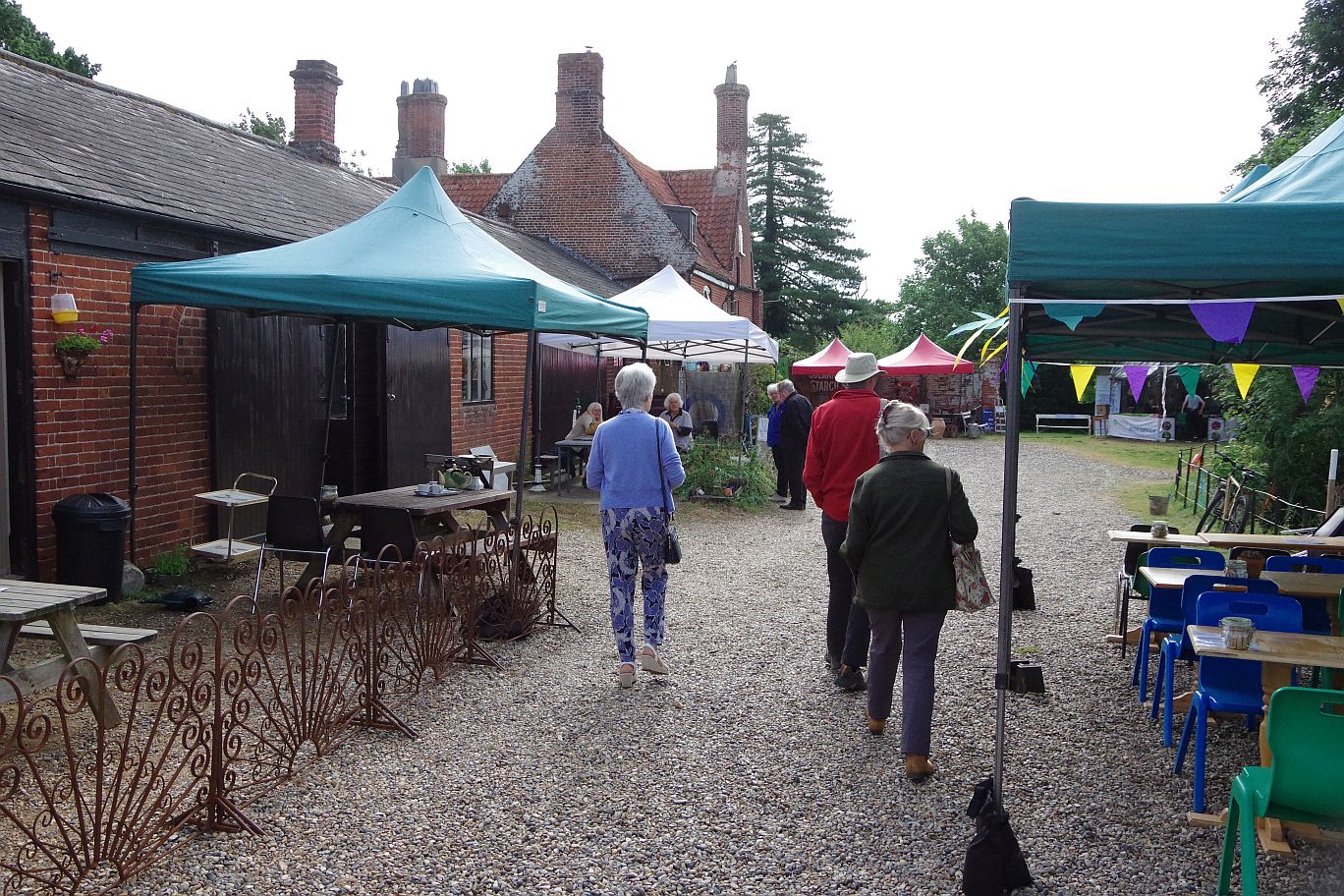
Today Linda, Sue, Peter and I made the short trip across Reedham Ferry to the annual exhibition of sculpture at Raveningham Hall. As was the case last year, some of the works were a little 'challenging', but the vast majority made us wish we had a few hundred pounds to spare...
Well worth a look: the event continues until September 8th.
Don't forget: you can click on an image to enlarge it!
Friday, 16 August 2019
Thursday, 15 August 2019
Survey at Hemblington Church: hundreds of dragonflies!
Today was the monthly wildlife survey at Hemblington Church, carried out by Linda, Joyce Burtenshaw, Sue Rowe and myself. Very few birds other than the usual Blue Tits, Buzzards and gulls, but the churchyard was full of dragonflies sheltering from the strong north-westerly wind. Most abundant were Migrant Hawkers: I counted 85 in one 'sweep' along the western hedge. Lots of Ruddy and Common Darters and just a couple of Southern Hawkers for good measure.
Plenty of butterflies, too: these were mostly Small White, but there were Large Whites, Gatekeepers, Red Admirals and a very faded and tatty Painted Lady. Some gorgeous bees enjoying the wildflower meadow, including lots of Honey Bees, Red-tailed and (so I'm told) Carder Bees. I know next to nothing about hoverflies, but there were plenty of those as well!
Tuesday, 13 August 2019
Perseid update
By 10.30pm the sky had clouded over completely, so I had an early night and set my 'mental clock' for 2.00am. When I got up, I found that, although the Moon was very bright, the clouds had disappeared and 'seeing' was pretty good. Between 2.00 and 3.00 I saw plenty of meteors: the average was around one per minute. By that time of night, Cassiopeia was nearly overhead and Ursa Major was hanging above the northern horizon. The majority of meteors I saw headed downwards from the zenith through Ursa Major. One or two were very bright indeed and left trails that persisted for several seconds.
Monday, 12 August 2019
Perseid meteor shower
It's that time of year again! Tonight (and for the next two or three nights) you stand a really good chance of seeing a few meteors: it's the annual 'maximum' of the richest of all the periodic showers, the Perseids.
Meteors are, of course, small particles of (usually cometary) debris that enter the Earth's atmosphere at high speed and burn up because of friction. The Perseids are generally the most dependable meteors, often being bright, abundant and long-lasting. Although the Moon is approaching 'full', it's on the other side of the sky and shouldn't be too much of a problem.
Meteors appear to originate from a point in the sky known as the radiant: in the case of tonight's shower, this is the region near the constellation of Perseus. At 10pm, Persues will be above the north-eastern horizon, below the easily-recognised 'W' of Cassiopeia. Happy shooting star-gazing!
Sunday, 11 August 2019
Odds and ends at a local open garden
Every year the lovely couple who own the old 'Bird in Hand' in the village open their garden to the public. Perhaps because of the tremendous bargains in plants to be had (or perhaps it's the Pimms bar!) the event is always well attended and raises a lot of money for the Church and Heathlands.
Today was bright and breezy and I should have been playing guitar in Acle: however, I woke up with virtually no voice, so there was little point in attending the jam: instead, I joined Linda, Sue and Peter at the open garden.
As well as the terrific plants, cream teas (and Pimms!) there were a few odds and ends worth pointing the camera at. Riding the front of an incoming squally cloud was a flock of Swifts. Every one was scrutinised, but none had a white rump! Migrant Hawkers were everywhere, and there were several pairs of Brimstones. Other birds included Marsh Harrier, Buzzard and Sparrowhawk.
Friday, 9 August 2019
Willow Emeralds, clouds of butterflies and Ruff: Strumpshaw Fen
I try to maintain an average of four or five miles walking every day: I've kept this up for eight years so far (with the help of my Fitbit!) The weather having been somewhat changeable since Monday's outing (and the meteorite business taking up a fair bit of time!) I grabbed the chance of a walk around Buckenham and Strumpshaw this afternoon.
About the only interesting encounter at Buckenham was with author Joe Harkness: he was just leaving the small recording studio at Buckenham Station as I walked back to the car park. I've never met Joe before, but I'm familiar with the impact of his well-received book 'Bird Therapy'. I found Joe to be a really decent bloke: we seem to share many of the same ideas about life, the universe and everything.
Strumpshaw mid-afternoon in August is not generally very productive, but in fact I found lots of things at which to point my camera. Red Admirals, Peacocks and Painted Ladies were everywhere: I must have seen four or five hundred of each as I 'did the circuit'. Equally numerous were Brown Hawkers and Ruddy Darters, with a few Migrants, Southerns and Black-tailed Skimmers to add variety. The scrape in front of Tower Hide seemed barren at first, with high water levels and reeds preventing a view of the margins. However, a Little Egret flew in to preen on the gull island and four Ruff emerged from the grass to feed.
Returning by way of Lackford Run, I stopped to look for Willow Emeralds and eventually found one close enough to photograph: what elegant damselflies they are!
Subscribe to:
Posts (Atom)